NEW: 3D-printed street furniture

Rethinking street furniture: 3D printing meets stainless steel

Are you ready for a new generation of 3D-printed street furniture?
Our street furniture is not simply a further development of existing designs – it is completely reimagined using large-format 3D printing. The ONTIGO range combines state-of-the-art additive manufacturing with over 40 years’ expertise in high-quality street furniture, thereby setting new standards in design, functionality and innovation.

Produced using an XXL 3D printer from 100 % recycled plastic waste, these robust, lightweight and sculptural elements redefine architecture and the design of public spaces. The precise printing process enables shapes that would be virtually impossible to achieve using traditional methods – resulting in forward-looking, durable and aesthetically sophisticated solutions for public spaces.

Furniture Printed from
100% recycled industrial films

ONTIGO marks the beginning of a new era in street furniture: the combination of innovative 3D printing technology and decades of expertise in the production of high-quality street furniture enables durable design solutions for both outdoor and indoor areas.

Whether in urban settings or in architecturally sophisticated interior spaces such as foyers or reception areas, these 3D-printed benches create functional spaces to linger in, characterised by clean lines and a forward-looking design.

At the heart of the series: a highly stable printing material made from 100% recycled industrial films, reinforced with glass fibers for maximum resilience. The system is complemented by powder-coated stainless steel components that ensure precision, durability and an elegant look.

What 3D printing offers

Only feasible with 3D printing

3D printing can be used to create shapes and structures that would either be impossible or very costly to realize using conventional processes and materials - without the need for complex mold production. This creates new freedoms in design and function.

Maximum stability

ONTIGO sets new standards compared to classic concrete elements. The 3D-printed modules impress with their high resistance - even with large volumes, they remain surprisingly light and extremely robust at the same time. This means they can withstand intensive use and are ideally equipped to withstand vandalism.

Surprisingly light - easy to handle

Compared to solid concrete elements, the ONTIGO modules weigh significantly less. A forklift truck is completely sufficient for transportation and positioning - heavy lifting equipment is not required.

Efficiently installed - ready for use in the shortest possible time

Thanks to the sophisticated design, the modules can be installed quickly and easily: Two people and a forklift truck are all you need. This reduces assembly work, saves resources and lowers overall costs.

Easy to clean

The surfaces can be easily cleaned with water - without chemical cleaning agents. A special plus: the modular bench has an integrated self-cleaning function in the water drain that automatically reduces soiling.

Printed furniture
withstand extreme loads

The precisely grooved surface structure of the 3D print gives each bench a striking look with a stylish appearance. Depending on the viewing angle and incidence of light, a lively interplay of reflection and shadow is created.

In addition to the aesthetic effect, the surface also scores points in functional terms: it is resistant to scratches, insensitive to dirt and virtually maintenance-free. Perfect for everyday use in public spaces.

Structure with function: the fine grooves ensure high scratch resistance
Light meets form: Changing effects through natural reflection
Pleasant feel: Matt, high-quality, modern
Easy to clean: Robust and easy to care for in everyday life

MODULAR BENCH

ONTIGO 10

Probably the longest printed bank in the world

Infinitely combinable and perfectly tailored to the needs of the site, with integrated drainage and other features. The more than 21 standard elements with planters, armrests or tables open up almost limitless possibilities.

Planters

ONTIGO 20

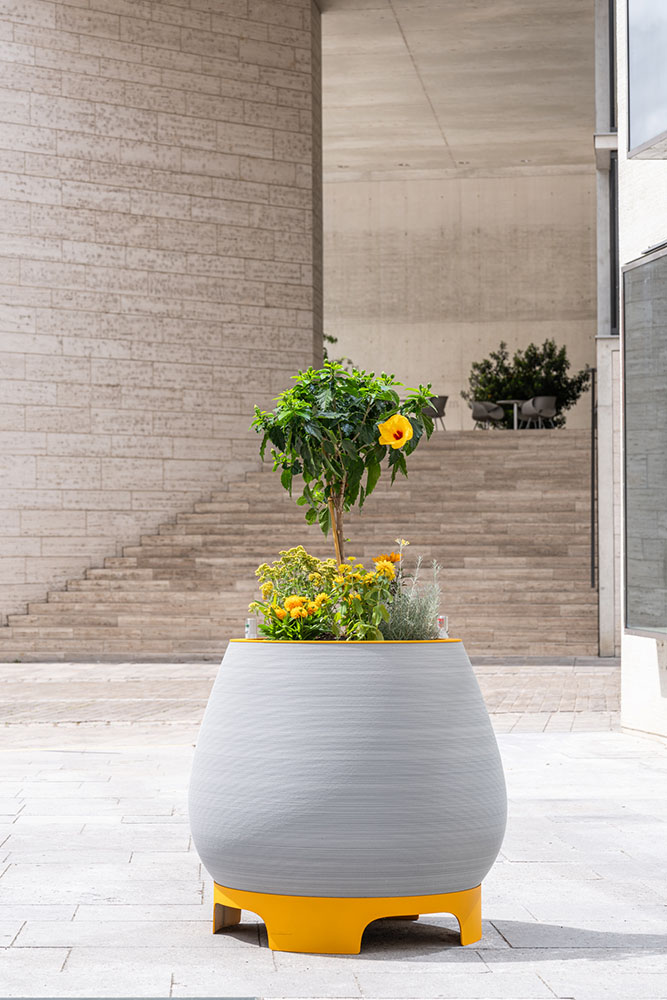
Planters, redefined – manufactured using 3D printing

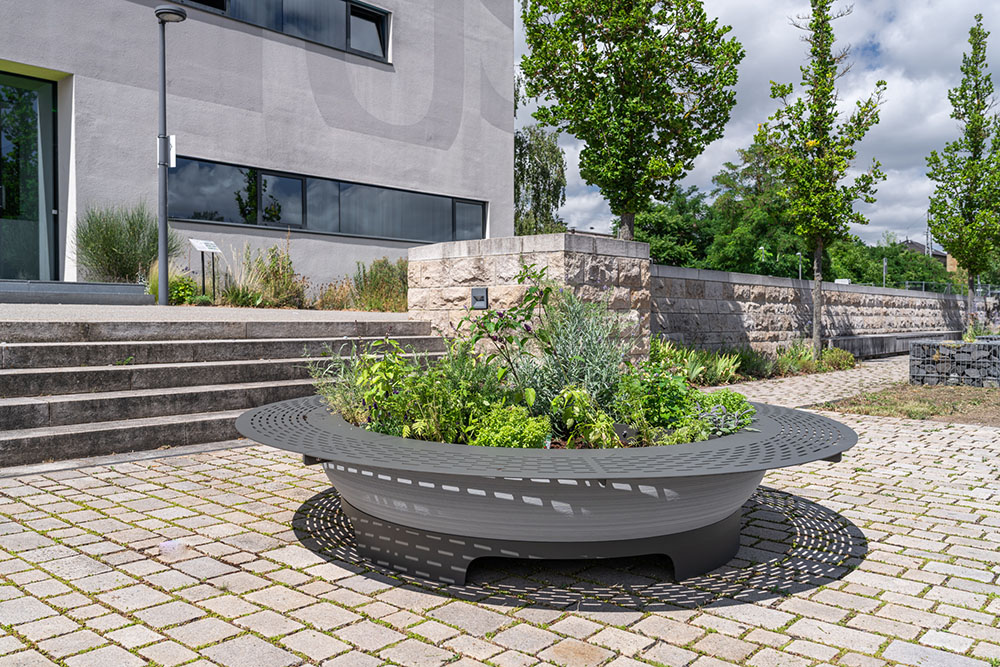
Available in three versions – with one, two or three integrated plant inserts – ONTIGO 20 offers flexible solutions for urban greenery with character. With integrated seating areas, sophisticated landscapes are created where the focus is on design.

Planters

ONTIGO 50

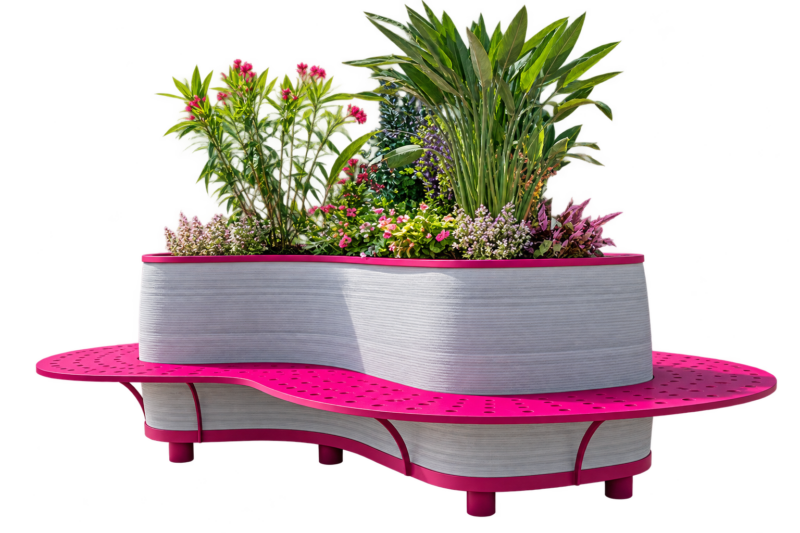
Planters THAT INVITE YOU TO LINGER

ONTIGO 50 combines organically shaped, 3D-printed planters with optional integrated stainless steel seating. The robust, lightweight material is made from 100 per cent recycled industrial film. The result is a range of exceptional design elements that combine greenery, design and a pleasant environment.

Many colours, many characters

ONTIGO is available in six timeless basic colours: white, mottled anthracite grey, mottled olive, mottled brown and mottled green. All the colours complement the grooved, matt surface, which impresses with its pleasant feel and high durability.

Colors for outdoor use

The mixed colours really come into their own in outdoor settings: the nuanced colour scheme lends the pieces depth, minimises visible signs of wear and enhances their visual longevity.

Stainless steel components

Stainless steel components can be custom-coated upon request—with over 8,500 color options to choose from, including all common standards such as RAL, NCS, and Pantone.

QUESTIONS from our customers

3D-printed street furniture is furniture for public spaces that is produced using large-scale 3D printing, also known as additive manufacturing. Our components are made from recycled industrial films, reinforced with glass fibres, and are combined with durable stainless steel elements.

No. The material is UV-resistant; the surface retains its colour and does not yellow. Even after years of outdoor use, the colours remain vibrant and consistent.

They are significantly lighter. A 3D-printed bench weighs only a fraction of a concrete piece of furniture of a comparable size. This makes transport, positioning and assembly much easier and more cost-effective.

Our 3D-printed street furniture is made from 100 % recycled plastic film, glass-fibre-reinforced material and powder-coated stainless steel. This combination ensures stability, durability and a high-quality finish.

Yes, absolutely! The furniture is UV-resistant, frost-proof, weather-resistant and very robust. Thanks to the glass-fibre-reinforced moulded components and the stainless steel, it can easily withstand intensive outdoor use.

3D-printed street furniture differs fundamentally from conventional concrete or cast furniture. As 3D printing does not require the creation of moulds, adjustments can be made at any time – without additional tooling costs or production delays. Even from the very first prototype, the shape, size, radii and functional details can be flexibly refined.

Unlike heavy concrete elements, 3D-printed furniture is significantly lighter, easier to transport and can often even be installed by just a few people. At the same time, 3D printing allows for greater design freedom, including organic shapes, modular systems and customised geometries that would be very difficult or impossible to achieve using traditional manufacturing methods. Through the use of recycled materials, the furniture is also more sustainable and conserves resources.

Yes. The plastic materials used are already derived from recycling processes and can be recycled time and time again. This creates a closed-loop material cycle.

  • 3D printing offers a range of advantages for street furniture that are virtually impossible to achieve using traditional manufacturing methods. Design freedom is particularly crucial: organic shapes, curved lines and complex geometries can be realised without the need for additional mould-making. This allows street furniture to be individually adapted to its surroundings – from long, flowing seating arrangements to modular planting systems.

    Another major advantage is the flexibility in product development. As no mould is required, models can be adapted, scaled or expanded at any time. Changes can be implemented quickly and are cost-effective even from the pilot production stage.

    Furthermore, 3D printing enables resource-efficient production: there is virtually no waste, and recycled materials such as reused industrial films are ideal for use in this process. As the weight is lower than that of concrete or cast iron, transport, handling and assembly are simpler and more cost-effective.

    3D printing also impresses when it comes to sustainability and durability. The glass-fibre-reinforced materials used are robust, UV-resistant, weatherproof and vandal-proof – perfect for demanding applications in public spaces.

Yes, our 3D-printed street furniture has been specially designed for outdoor use and is therefore heat-resistant, frost-resistant and weather-resistant. The material used is glass-fibre-reinforced and therefore extremely sturdy – even when exposed to significant temperature fluctuations.

The furniture can withstand both intense UV radiation in summer and frost and sub-zero temperatures in winter without warping or becoming brittle. Rain, snow, heat or direct sunlight do not affect either its structure or its surface.

Thanks to the combination of robust 3D-printed material and powder-coated stainless steel, the furniture is ideally suited to high-traffic, permanently unprotected outdoor areas.

Yes. The components are made from glass-fibre-reinforced, recycled material and are designed to withstand heavy use. Even when subjected to intensive use – for example, in parks, schools, pedestrian areas or on university campuses – the furniture retains its structural integrity and safety.

Die Bänke sind so konstruiert, dass sie auch bei hoher Personenfrequenz standhalten. Die Kombination aus 3D-gedruckten Strukturen und Edelstahl sorgt für eine hohe Tragfähigkeit. Je nach Modell sind mehrere hundert Kilogramm kein Problem.

It’s quite simple: just use water or a mild detergent. The matt, textured surface is easy to look after and does not allow dirt to penetrate deeply. Graffiti can often be removed – depending on the colour – using suitable cleaning products.

Designing favourite places together.
Make an appointment now.

Jochen Benkert

CEO

You would like to learn more about our products and have a specific project in which our furniture is to be used?
Then arrange a consultation appointment with us at any time and we will find the right product for your project.

We are looking forward to meeting you!